
SASSA Means Test – Asset and Income Threshold 2026
The SASSA means test is a financial assessment used to determine if an individual or household qualifies for a social grant. By checking income and assets against specific thresholds, the South African Social Security Agency ensures that government assistance reaches those who need it most.
(last updated: 21 May 2026)
Maximum income threshold for SASSA grants
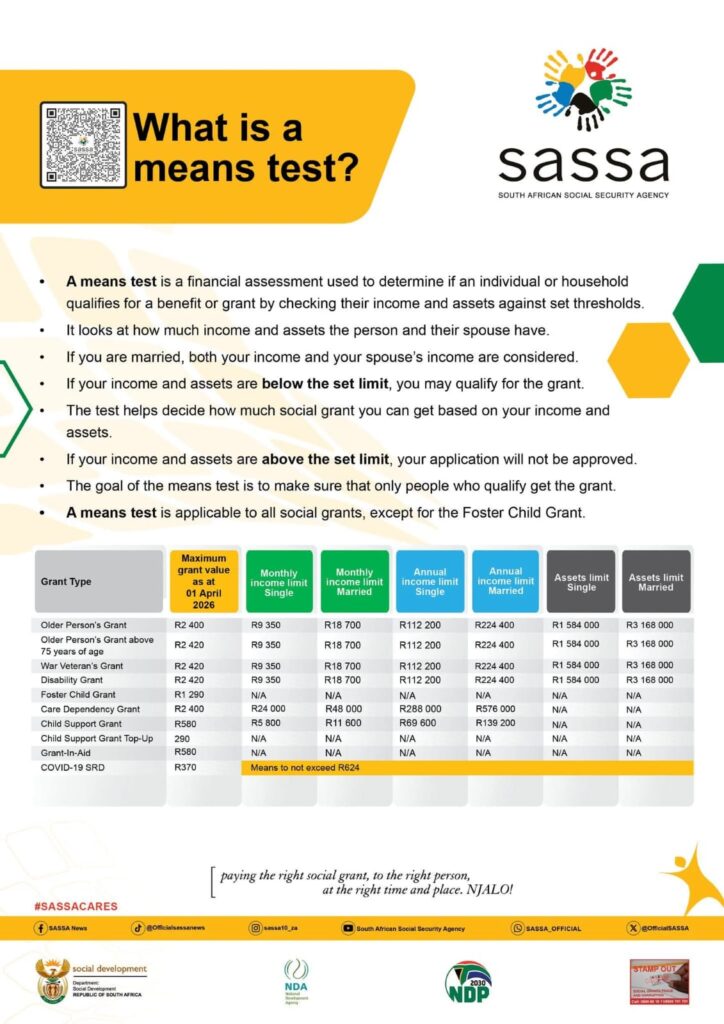
Please note that the following asset and income threshold are the current amounts from 1 April 2026. These amounts are subject to change again, and we will update this page accordingly.
- SRD grant: you must NOT earn more than R624 per month
- Child support grant: you (the primary caregiver of the child you are applying for) must NOT earn more than:
- R5 800 per month (R69 600 per annum) if you are single
- R11 600 per month (R139 200 per annum) if you are married
- Care Dependency grant: you (the primary caregiver of the child you are applying for) must NOT earn more than:
- R24 000 per month (R288 000 per annum) if you are single
- R46 800 per month (R576 000 per annum) if you are married
- Disability grant: you must NOT earn more than:
- R9 350 per month (R112 200 per annum) if you are single
- R18 700 per month (R224 400 per annum) if you are married
- Older persons grant: you must NOT earn more than:
- R9 350 per month (R112 200 per annum) if you are single
- R18 700 per month (R224 400 per annum) if you are married
- War Veterans grant: you must NOT earn more than:
- R9 350 per month (R112 200 per annum) if you are single
- R18 700 per month (R224 400 per annum) if you are married
- Child support grant top-up: there is no income/ asset/ means test applicable for this type of grant
- Grant-in-Aid: there is no income/ asset/ means test applicable for this type of grant
- Foster child grant: there is no income/ asset/ means test applicable for this type of grant
Applicants who are married will have their applications assessed with theirs and their spouses’ combined incomes, regardless of whether applicants are married in community of property or out of community of property.
Maximum asset threshold for SASSA grants
(These values are valid from 1 April 2026)
- Disability grant: you must NOT have assets worth more than:
- R1 584 000 if you are single
- R3 168 000 if you are married
- Older persons grant: you must NOT have assets worth more than:
- R1 584 000 if you are single
- R3 168 000 if you are married
- War Veterans grant: you must NOT have assets worth more than:
- R1 584 000 if you are single
- R3 168 000 if you are married
- Grant-in-Aid: not applicable for this type of grant
- Child support grant: not applicable for this type of grant
- Foster child grant: not applicable for this type of grant
- Care Dependency grant: not applicable for this type of grant
- SRD grant: not applicable for this type of grant
What counts as an “asset” in terms of the SASSA means test?
The means test will consider the following as “assets”, which will determine whether you qualify for a grant:
- The value of a property or land you or your spouse own (except for the property that you live in) (properties or land that have an outstanding bond registered over it, are deemed to have 0 value)
- Cash in yours or your spouses bank account
- Investments (such as shares or unit trust funds), owned by yourself or your spouse
- Retirement fund: if you have NOT retired from the fund yet, your annuity will NOT form part of the means test
- Retirement fund: if you have retired from the fund, your annuity will form part of the means test
What counts as an “income” in terms of the SASSA means test?
The means test will consider the following as “income”, which will determine whether you qualify for a grant:
- Income from work you do
- Income from a private pension fund
- Income from renting out a room in your house
- Income from renting out any other property you own
- Income from farming or from any business
- Financial support from relatives
- Maintenance received for your child
- Compensation from from UIF, Road Accident Fund or Compensation for Occupational Injuries and Diseases Fund (COIDA)
SASSA will use your combined income net of tax and allowable deductions (such as contributions to a medical scheme), to calculate your grant. You must inform SASSA of any changes to your income and deductions.
Deductions when calculating income – you are allowed to deduct the following:
- Your medical aid payments
- Your UIF payments
- Your income tax paid
- Your contributions to a pension fund or retirement annuity
Important things to note:
- If your income and/or assets are higher than the threshold amount, they will not qualify for a social grant.
- If your spouse already receives a social grant, their grant is NOT counted as income in your application.
- If your spouse has deserted you for more than 3 months, then your marital status will not taken into account, however you will need to submit an affidavit to attest to the desertion.
- Foster Child Grant is the only Social Grant that is NOT subject to a means test.
Find out more about each type of SASSA grant here:
SRD R370 Grant Care Dependency Grant Child Support Grant Foster Child Grant Disability Grant Older Persons Grant Grant-In-Aid War Veterans Grant
You may be interested in reading about:
Types of Grants How to Apply Status Check Payment Dates Jobs & Vacancies Updates & Blog Contact SASSA
Contact SASSA
For any further queries, please contact SASSA directly:
Contact the SASSA Toll Free Call centre on: 0800 60 10 11
Contact the SASSA Head Office on: 012 400 2322
Email SASSA Head Office at: Grantsenquiries@sassa.gov.za
Contact details of SASSA offices across the country: SASSA contact details
article source: SASSA official website
written by: Thabo Maseko